Nine examples from the same copy of Nader K. Rad’s PMBOK® Guide 7, Underneath the Surface. The passage on the left is the starting point; the Map on the right is what the question produced.
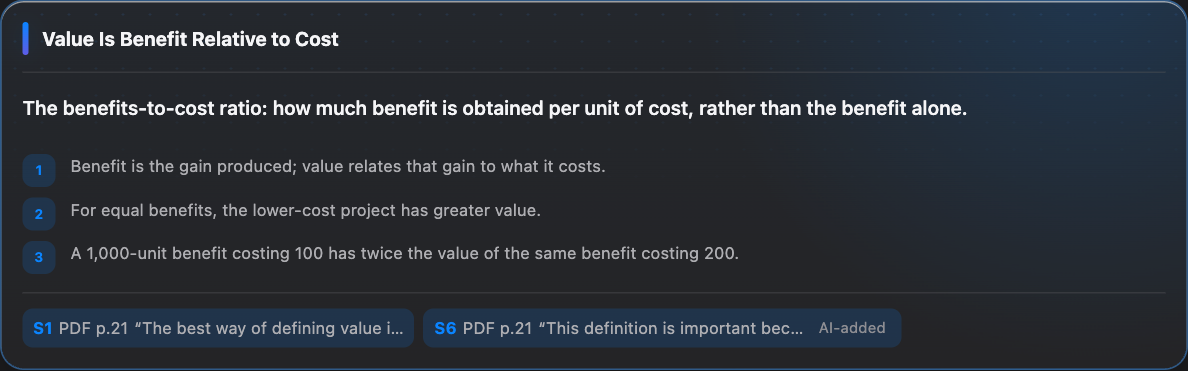
Value is benefit divided by cost—not benefit itself
Value is not the benefit itself; it expresses how much benefit is obtained relative to cost.
PMBOK® Guide 7p.21
PMBOK® Guide 7 · Underneath the Surface
The best way of defining value in this context is the benefits-to-cost ratio. So, if you have two projects and they both benefit you by 1,000 units of money, but one costs you 100 units to do and the other 200, the first one is twice as valuable.
→
02TablePDF p.35
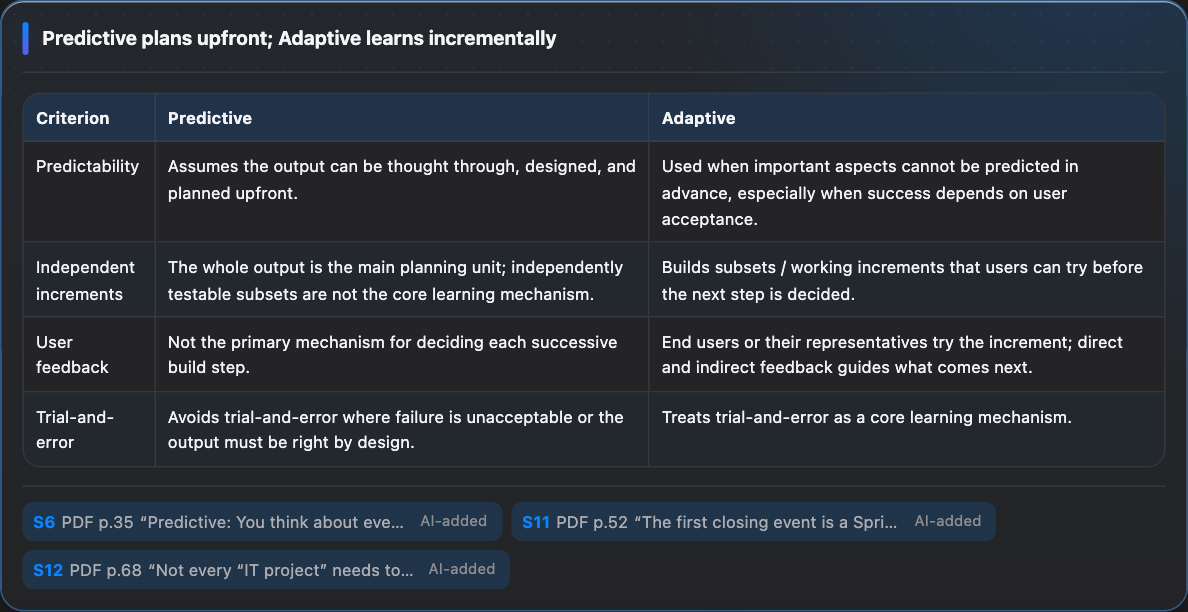
Four conditions that separate Predictive from Adaptive
Predictive is strongest when the result can be specified before construction; Adaptive is strongest when user acceptance makes the result uncertain and learning must occur through working increments, feedback, and controlled trial-and-error.
PMBOK® Guide 7p.35
PMBOK® Guide 7 · Underneath the Surface
2.1.11.1. Adaptive vs. predictive
→
03ComparisonPDF p.45
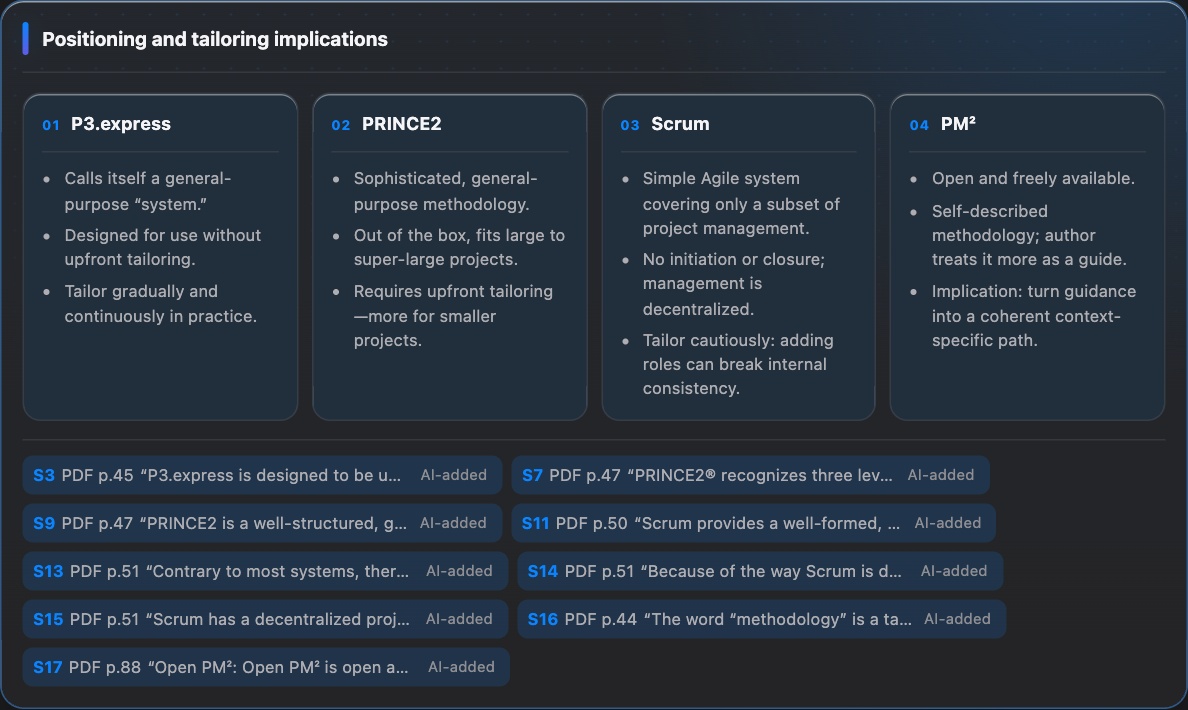
How do P3.express, PRINCE2, Scrum, and PM² differ?
The book distinguishes them chiefly by how complete and prescriptive a path they provide, which changes when and how tailoring should occur.
PMBOK® Guide 7p.45
PMBOK® Guide 7 · Underneath the Surface
3.1. P3.express
→
04FlowPDF p.29
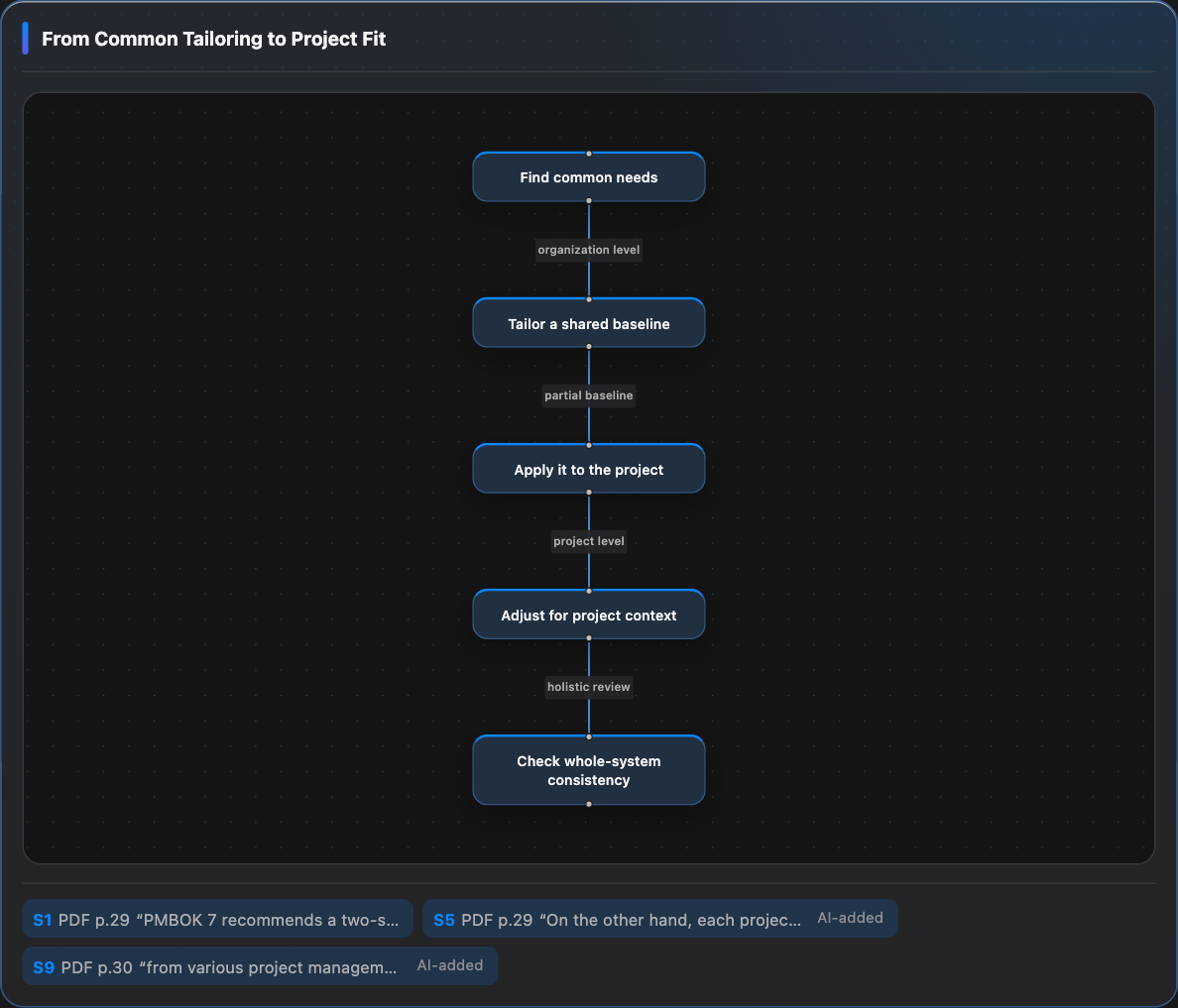
Tailoring moves from organization-wide to project-specific
Start with a shared organizational baseline, adapt it to each project, then verify that the resulting system still works as a coherent whole.
PMBOK® Guide 7p.29
PMBOK® Guide 7 · Underneath the Surface
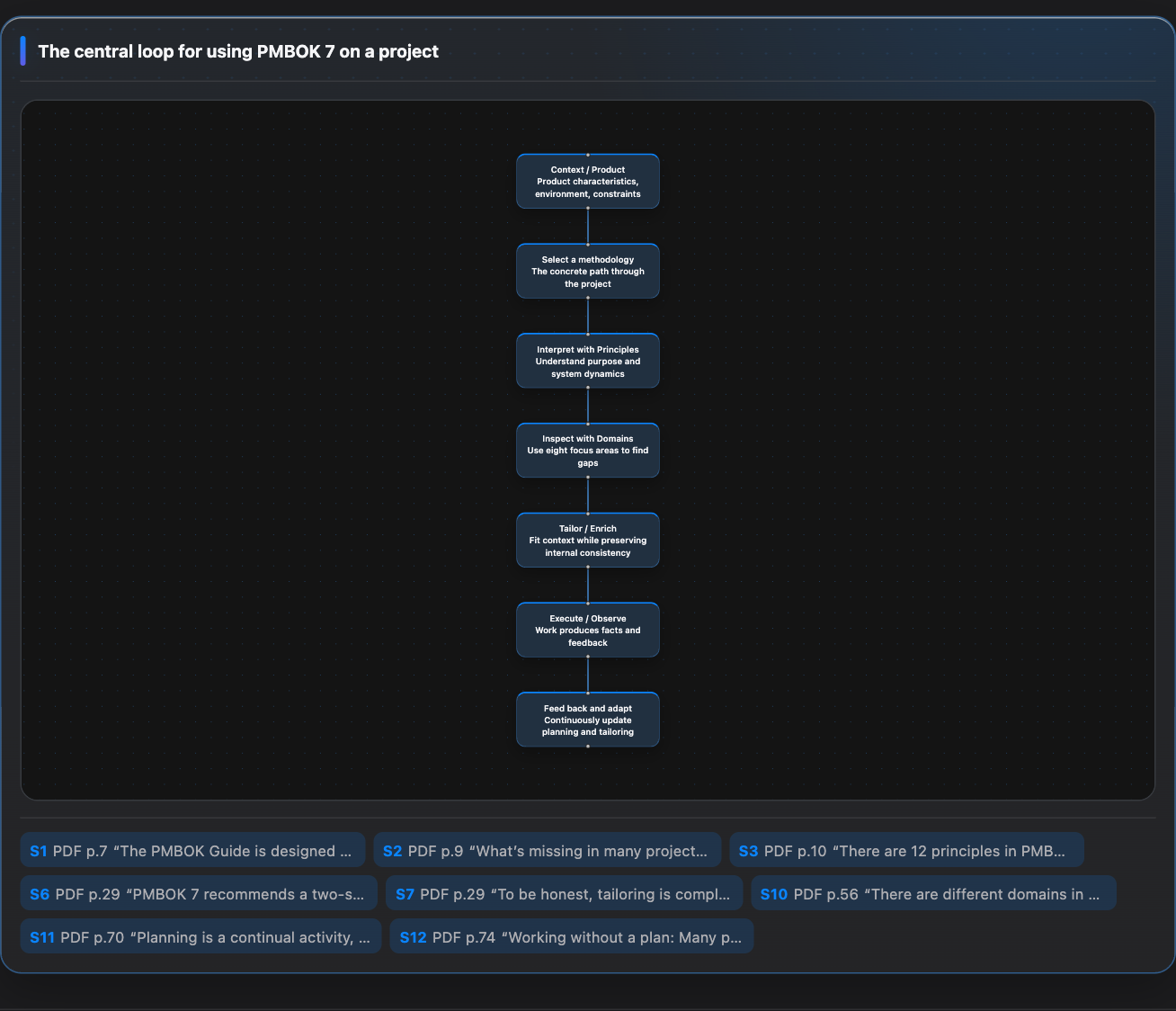
PMBOK 7 recommends a two-step tailoring process: first, a high-level, partial tailoring for all projects in the organization, and then a final tailoring for each project. This is so because usually there’s a lot in common among projects being done in a single organization. So, instead of leaving the whole tailoring effort to individual projects, we can simplify the process and make projects more uniform by doing the high-level tailoring at the organization level.
→
05HierarchyPDF p.44
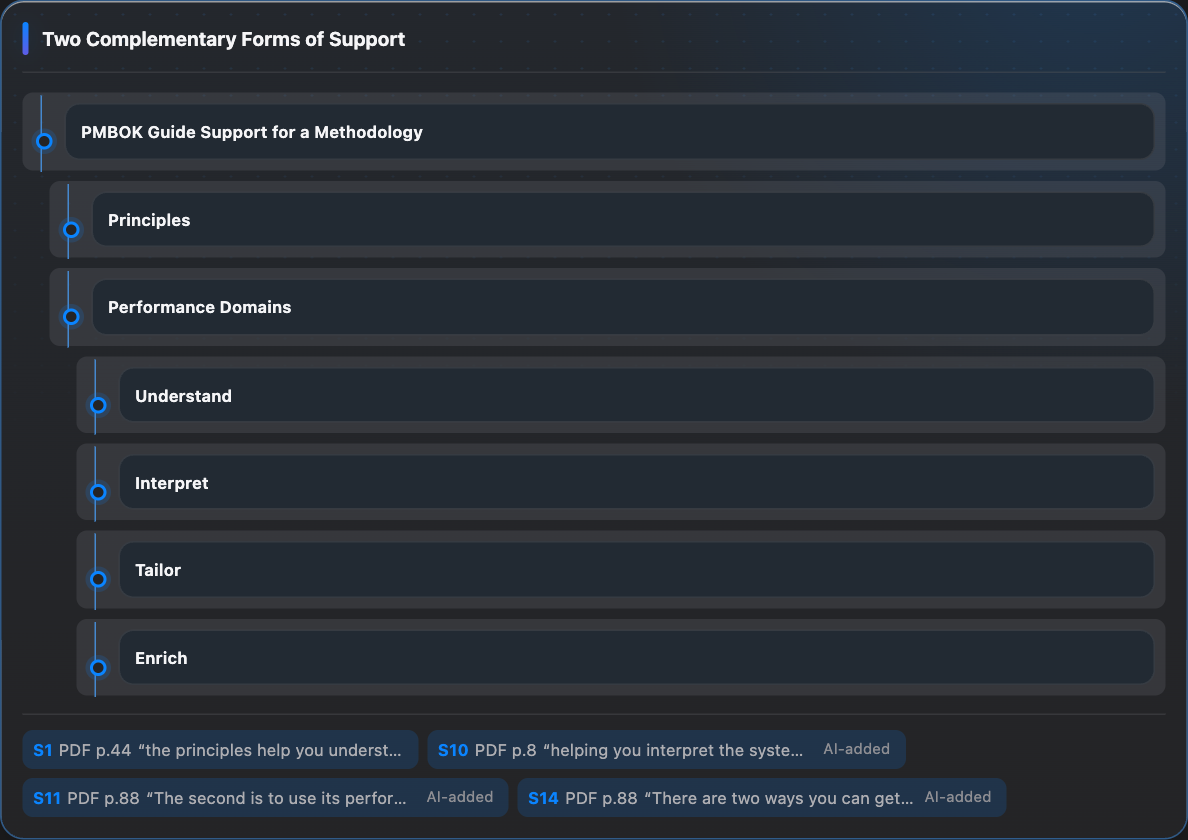
Principles interpret; Performance Domains enrich the methodology
The guide supports methodology use in two complementary ways: principles improve understanding and interpretation, while performance domains support tailoring and enrichment.
PMBOK® Guide 7p.44
PMBOK® Guide 7 · Underneath the Surface
the principles help you understand and interpret everything more effectively (the topic of the previous chapter), and the performance domains help you enrich the methodology (the subject of the next chapter).
→
06TimelinePDF p.46
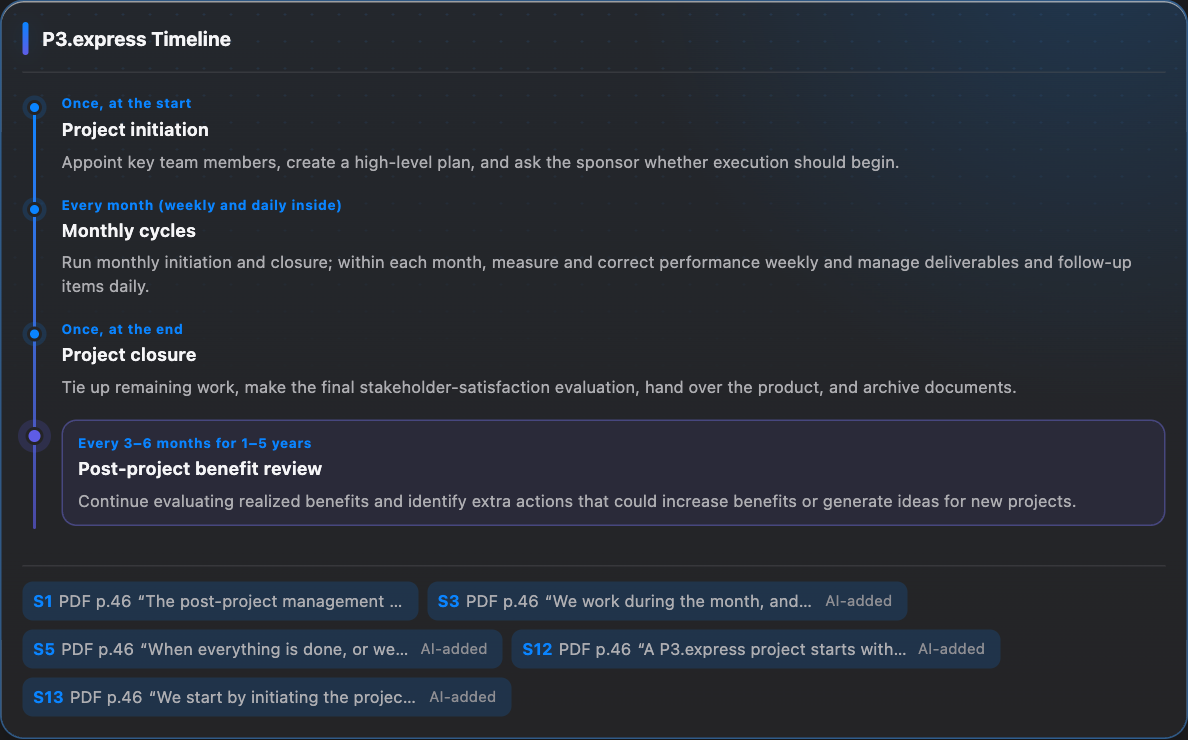
Project closure is not the end: benefits are tracked for 1–5 years
P3.express widens its management cadence from daily and weekly work inside monthly project cycles to benefit reviews every 3–6 months for 1–5 years after closure.
PMBOK® Guide 7p.46
PMBOK® Guide 7 · Underneath the Surface
The post-project management cycles repeat every 3 to 6 months for 1 to 5 years, depending on the project, to evaluate its benefits and come up with extra actions that can increase benefits, or ideas for new projects.
→
07MatrixPDF p.68
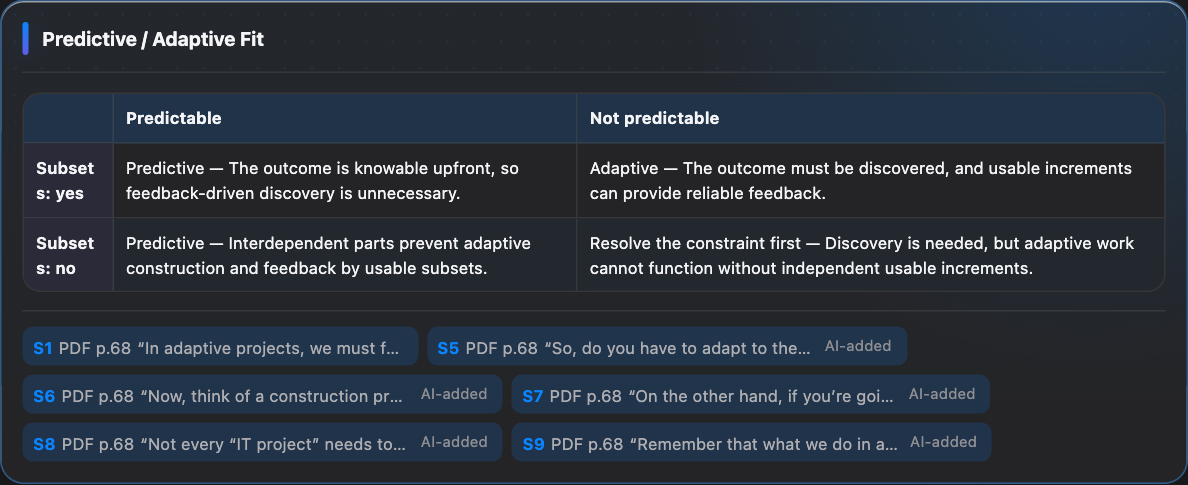
Two conditions that make Adaptive viable
The matrix separates the need for feedback-driven discovery from the feasibility of obtaining that feedback through independently built, usable increments.
PMBOK® Guide 7p.68
PMBOK® Guide 7 · Underneath the Surface
In adaptive projects, we must focus on subsets of the product and specify, design, and build them without the rest. It must be done without the rest because if you design everything, then your choices for the future will be limited and you won’t be able to adapt. Finally, the output has to be in increments that people can actually use, because that’s the only way we can collect reliable feedback.
→
08ChartPDF p.39
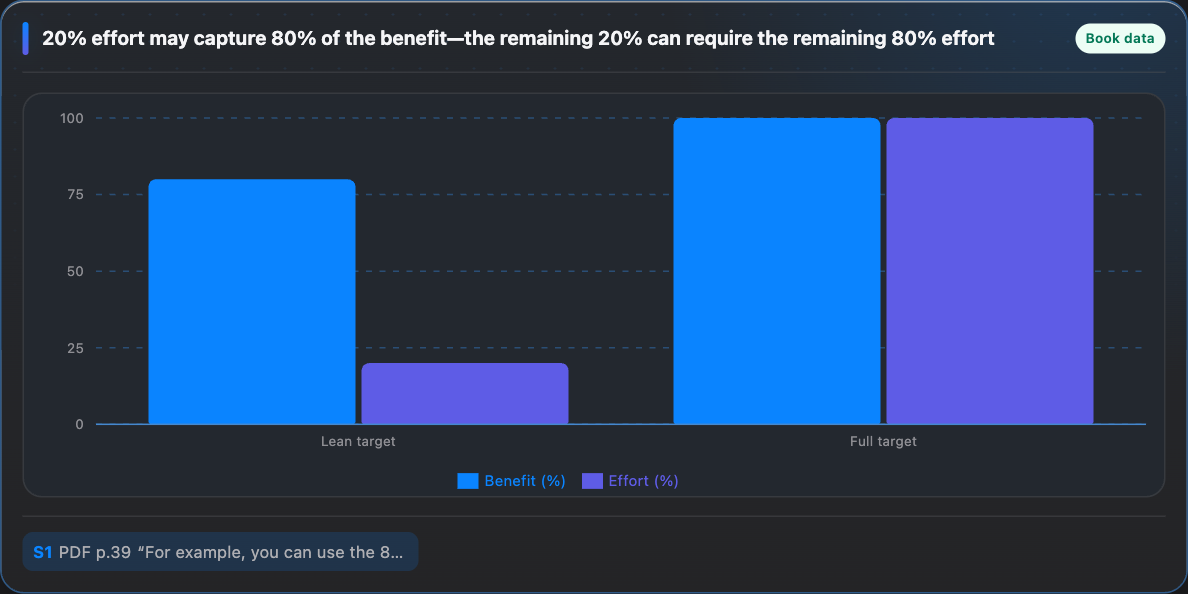
The last 20% of benefit can consume the remaining 80% of effort
The 80/20 rule highlights sharply declining efficiency: 20% effort may capture 80% of the benefit, while capturing the remaining 20% benefit can require the remaining 80% effort.
PMBOK® Guide 7p.39
PMBOK® Guide 7 · Underneath the Surface
For example, you can use the 80/20 rule, also known as Pareto law, in your project management system: Instead of trying to achieve 100% of the potential benefits of structured project management with 100% of effort, target 80% of the benefits, which may take only 20% of the effort.
→
09CalloutPDF p.29
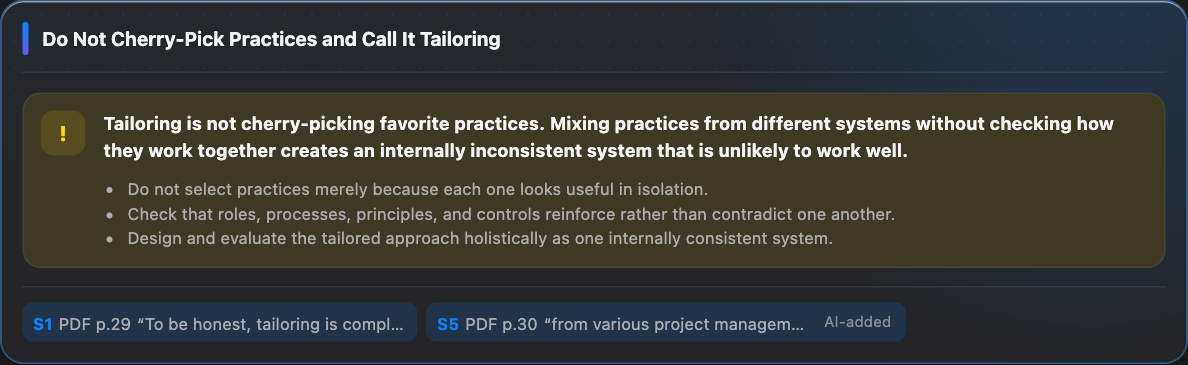
Tailoring is not cherry-picking
Treat tailoring as the design of a coherent project-management system, not as a collection of individually appealing practices.
PMBOK® Guide 7p.29
PMBOK® Guide 7 · Underneath the Surface
To be honest, tailoring is complicated! Some people simply start cherry-picking